Why Does My Boiler Keep Losing Pressure?
Short answer: A boiler that keeps dropping to zero pressure has a leak somewhere — visible or hidden — or a failed expansion tank combined with relief-valve discharge. Top it up to 12–15 psi cold and watch: if it drops again within days, call a technician to find the leak.
Short answer: A boiler that keeps dropping to zero pressure has a leak somewhere — visible or hidden — or a failed expansion tank combined with relief-valve discharge. Top it up to 12–15 psi cold and watch: if it drops again within days, call a technician to find the leak.
Pressure loss is one of the most common boiler complaints, and it's also one of the most misunderstood. Your boiler is a sealed system — the same water circulates for years. It shouldn't need regular topping up. If you're adding water frequently, water is leaving, and the only question is where.
Losing pressure repeatedly? Call Ember Heat: (860) 650-9760
What's Normal (and What Isn't)
First, the baseline. On a cold boiler, the pressure gauge should read roughly 12–15 psi for a typical one- or two-story home. As the boiler heats up, pressure rises — water expands when heated — and readings up to 20–25 psi on a hot system are normal. When it cools, pressure falls back.
What's not normal: pressure dropping to zero (or near it) between heating cycles, needing to top up weekly or monthly, or the gauge reading zero on a cold boiler that was fine last week. A sealed system doesn't consume water. Repeated top-ups mean a leak — full stop.
One exception: right after servicing or bleeding radiators, pressure drops because water was removed. Topping up once after maintenance is normal. Topping up again a week later is not.
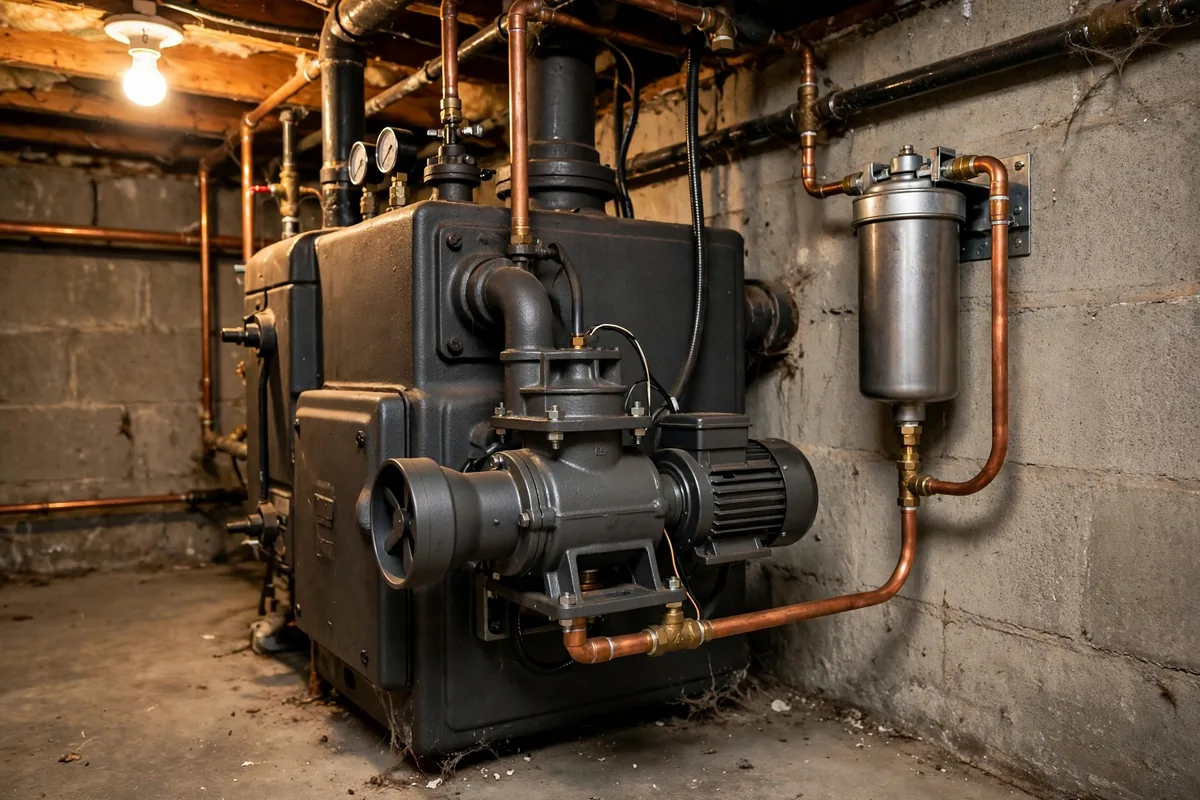
Cause #1: A Leak Somewhere in the System
This is the most common cause, and the leak isn't always obvious. Check the visible suspects first:
- Radiator valves and bleed valves — look for staining, mineral crust, or dampness around valve bodies and connections.
- Baseboard piping — check along runs and at fittings for weeping or staining.
- The boiler itself — inspect around the base, at pipe connections, the relief valve discharge pipe, and underneath. A small puddle that evaporates between visits still counts.
- The pressure relief valve discharge pipe — if this pipe is wet or dripping, the relief valve has been opening. That's a symptom (see Cause #2), but it confirms water is leaving.
Hidden leaks are the tricky ones: pinholes in piping inside walls, under slabs (slab-on-grade radiant or buried runs), or slow weeps at fittings in crawl spaces. Signs of a hidden leak with no visible water: pressure drops steadily, you hear the auto-fill valve running frequently (a faint hissing/water sound near the boiler when it should be quiet), or your water bill creeps up if the auto-fill is connected.
Finding hidden leaks is detective work — isolating zones, pressure-testing sections, sometimes thermal imaging. That's technician territory.
Cause #2: Failed Expansion Tank + Relief Valve Discharge
This one confuses people because there's no "leak" in the usual sense. Here's the mechanism: water expands as it heats. The expansion tank absorbs that expansion — it's a tank with a rubber bladder, air on one side, system water on the other. When the bladder fails (or the tank waterlogs on old-style tanks without bladders), there's nowhere for the expanding water to go, so pressure spikes as the boiler heats.
At around 30 psi, the pressure relief valve opens — as designed — and dumps water to protect the system. Then the boiler cools, pressure drops, and the cycle repeats. Each cycle ejects water. The gauge reads low, you top up, and the whole thing happens again.
The telltale sign: the relief valve's discharge pipe is wet, or you find water beneath it. The fix is replacing the expansion tank (and checking the relief valve afterward — repeated discharge wears them out). This is one of the most common and most fixable pressure-loss causes we see.
Cause #3: The Pressure Relief Valve Itself
Sometimes the relief valve is the problem rather than the symptom. Old relief valves develop weak springs or debris on the seat, and they start weeping or opening below their rated pressure. If the discharge pipe drips steadily even at normal pressure readings, the valve itself may have failed.
Relief valves are safety devices with a finite life. We test them during maintenance and replace them when they're suspect — a relief valve you can't trust is worse than useless, because it invites complacency.
Cause #4: Auto-Fill Valve Issues
The pressure-reducing (auto-fill) valve adds makeup water to maintain system pressure. If it fails, it can either stop feeding (pressure drops and stays down — you'd notice the boiler struggling or locking out on low water) or overfeed (masking a leak by constantly replacing lost water — you'd notice the feed running often, or not notice at all until the leak gets big).
An overfeeding fill valve is sneaky: it hides the leak while continuously introducing fresh oxygenated water, which accelerates internal corrosion. If your fill valve seems to run frequently, that's worth investigating even if the gauge looks okay.
Why You Shouldn't Just Keep Topping Up
It's tempting to treat the fill valve as the solution — pressure low, add water, done. But every gallon of fresh water brings dissolved oxygen and minerals into a system designed to run on the same treated water for years. Oxygen corrodes steel and cast iron from the inside. Minerals form scale on the heat exchanger (hello, kettling). The leak you're masking is actively shortening your boiler's life with every top-up.
Find the leak. Fix the leak. Then the pressure stays put.
What We'll Do
A pressure-loss diagnosis goes in order: verify the gauge is accurate (old gauges lie), inspect all visible piping, valves, and the boiler for leaks, test the expansion tank's charge and bladder, check the relief valve's function, and verify the fill valve's operation. If everything visible checks out, we isolate zones and pressure-test to find the hidden leak.
Most pressure-loss cases resolve to one of the causes above — and most are very fixable. The expensive outcome is the leak ignored for two heating seasons, not the leak found in October.
Stop topping up and start fixing: call Ember Heat at (860) 650-9760 215 E Main St, Torrington, CT 06790 — boiler repair across Torrington, CT.
No heat? Call Ember Heat.
Boiler repair, installation, and maintenance across Torrington, Connecticut — diagnosed properly, explained plainly, fixed right.