My Boiler Is Leaking Water — Is It Dangerous?
Short answer: Water leaking from a boiler is usually a property-damage risk rather than an immediate safety emergency — but don't ignore it. The exceptions: heavy discharge from the pressure relief valve (possible overpressure), any gas smell (leave and call the gas company), or strong oil odor with visible leaking. When in doubt, call a technician.
Short answer: Water leaking from a boiler is usually a property-damage risk rather than an immediate safety emergency — but don't ignore it. The exceptions: heavy discharge from the pressure relief valve (possible overpressure), any gas smell (leave and call the gas company), or strong oil odor with visible leaking. When in doubt, call a technician.
Finding water under your boiler is unsettling, and the internet doesn't help — every forum thread swings between "it's fine, top it up" and "your house will explode." The reality is more nuanced. Here's how to assess a boiler leak calmly and what to do next.
Boiler leaking? Call Ember Heat: (860) 650-9760
First: Figure Out Where the Water's Coming From
Not all water near a boiler is a boiler leak. Before anything else, identify the source:
- Condensation or humidity. Basements are damp. A cold pipe sweating in a humid basement looks like a leak but isn't one. If the "leak" appears on warm humid days and the pipes are cold to the touch, suspect condensation first.
- The pressure relief valve discharge pipe. This pipe (usually copper, running from the relief valve down toward the floor) dripping or flowing means the relief valve has opened — that's a pressure issue, not a pipe leak. See below.
- A specific fitting, valve, or pump seal. Weeping around a circulator pump flange, a zone valve body, or a threaded fitting is a seal failure — common, fixable, and not dangerous in itself.
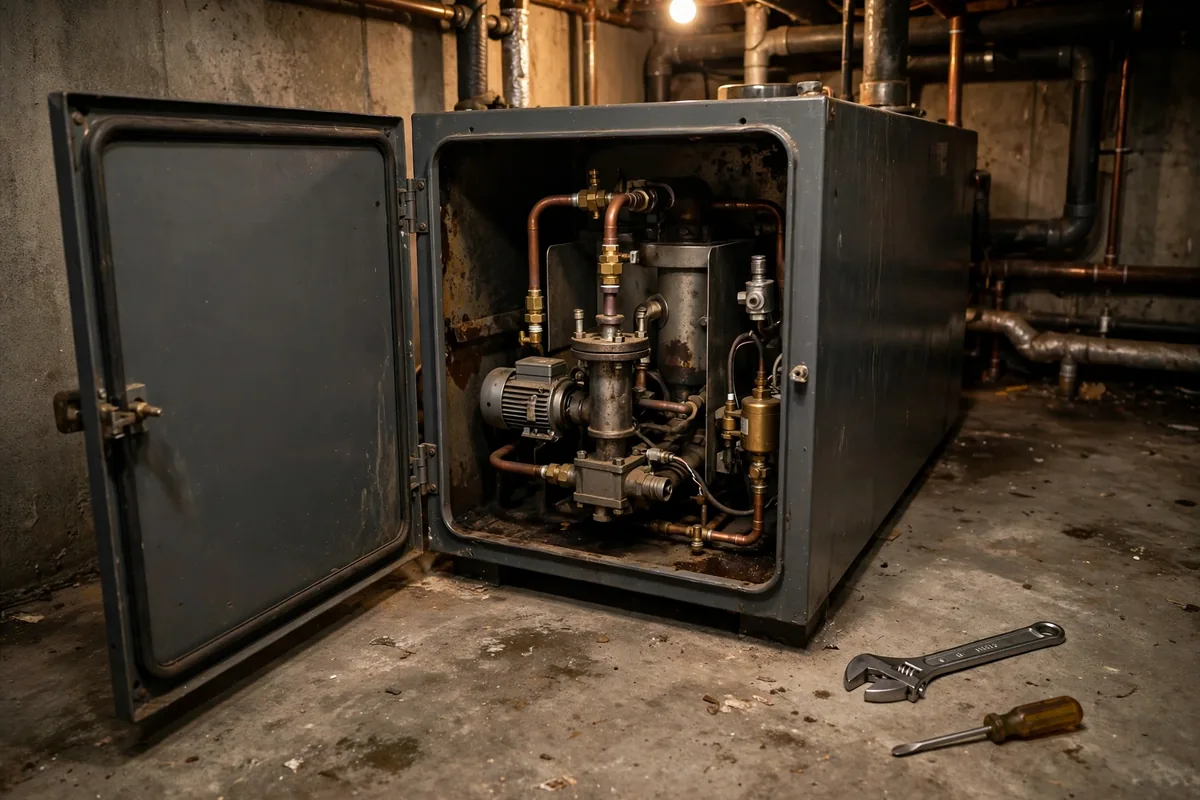
- The boiler block itself. Water seeping from between boiler sections or from the heat exchanger is the serious one — it usually means a cracked section, and that's typically the end of the boiler's life.
- Nearby plumbing. Water heaters, washing machines, and basement plumbing all share space with boilers. Make sure the water is actually coming from the heating system before diagnosing the boiler.
Dry the area, lay down newspaper or paper towels, and check back in a few hours. The location of the wet spot tells you a lot.
When It's Urgent
Call for prompt service — don't wait for a convenient appointment — if:
- The relief valve is discharging heavily. The relief valve opens at around 30 psi to protect the system from overpressure. A valve that's flowing significantly means pressure is out of control. Check the pressure gauge: if it's pinned high, this is urgent. The relief valve is the last line of defense — if it's already working hard, you want a technician there.
- There's a lot of water, fast. A burst pipe, a blown pump seal, or a major fitting failure can put gallons on the floor quickly. Shut the boiler's water feed valve if you can reach it safely (it's on the water line feeding the boiler), and call.
- You smell gas. Rotten-egg odor anywhere near a gas boiler: don't investigate, don't flip switches — leave the house and call the gas company from outside.
- You smell strong heating oil with visible leaking. Ventilate the area and call a professional. Oil leaks don't improve on their own.
- Steam is venting anywhere it shouldn't. Steam at system pressure can cause severe burns. Don't approach — call.
When It's "Schedule a Visit Soon"
These are real problems, but not emergencies:
- Slow weep from a valve or fitting. A fitting that leaves a damp spot or a slow drip is a repair job, not a crisis. Put a bucket under it, keep an eye on the boiler's pressure gauge, and schedule a visit. Don't let it run for months, though — slow leaks corrode everything they touch.
- Occasional relief valve weeping. A few drops after the system heats up can indicate early expansion-tank failure or a tired valve. Worth a scheduled visit before it becomes a heavy discharge.
- Dampness around the boiler base with no active drip. Could be an old stain, condensation, or a very slow seep. Monitor it — mark the edge of the damp area and see if it grows.
The Relief Valve Deserves Special Attention
The pressure relief valve is the most misunderstood component in this whole discussion. Its job is to open and dump water if system pressure exceeds safe limits (typically 30 psi on residential boilers). When it discharges, it's doing its job — but it's telling you something is wrong upstream, usually a failed expansion tank letting pressure spike.
A relief valve that has discharged repeatedly may not reseat properly afterward — they wear with use. So a discharge event often ends with two problems: the failed expansion tank that caused it, and a relief valve that now weeps. We check both.
Never plug, cap, or restrict a relief valve's discharge pipe. Never. It's the one device standing between an overpressure event and a catastrophic boiler failure. If it's discharging, the answer is to fix the pressure problem, not silence the messenger.
What a Leak Does If Ignored
Water leaks don't stay small. A weeping fitting corrodes and the weep becomes a drip, then a stream. Chronic low water from an unaddressed leak means the auto-fill keeps adding fresh oxygenated water, which corrodes the boiler from the inside and forms scale on the heat exchanger. On steam systems, constant makeup water is especially destructive — every gallon of fresh water shortens the boiler's life.
And then there's the basement: water damages flooring, walls, stored belongings, and creates mold conditions. The repair for the leak is almost always cheaper than the repair for the leak plus the water damage.
What We'll Do About It
A leak call goes like this: we trace the water to its exact source (dye, inspection, pressure testing if needed), assess whether it's a component failure (pump seal, valve, fitting — very fixable) or a boiler failure (cracked section — replacement conversation), and fix what's fixable. If the relief valve is involved, we diagnose the pressure side too — expansion tank, fill valve, gauge accuracy.
If the news is bad — a cracked block on an old boiler — we'll tell you straight, explain your replacement options, and help you plan. We won't sell you a repair that can't hold.
The Bottom Line
Most boiler leaks are fixable problems, not emergencies — but every leak deserves attention, and some demand it immediately. When in doubt, err on the side of calling. We'd rather tell you it's a ten-dollar gasket than have you discover it's a cracked section six months later.
Water where it shouldn't be? Call Ember Heat: (860) 650-9760 215 E Main St, Torrington, CT 06790 — boiler repair across Torrington, CT.
No heat? Call Ember Heat.
Boiler repair, installation, and maintenance across Torrington, Connecticut — diagnosed properly, explained plainly, fixed right.